

I often joke that I’m an expert at overthinking. I’ve replayed conversations for days, analyzed decisions from every angle, and painted a hundred different “what if” scenarios before anything has even happened. Does that sound familiar? Then you also know how draining it can be.
It’s like the mind never gets a break. And the more you try to “think it through,” the more stuck you become. Overthinking is something many of us struggle with – especially when we’re stressed, tired, or worried.
But why do we get stuck in overanalyzing, and how can we learn to let go?
Why do we overthink?
Overthinking is often the brain’s way of trying to protect us. We analyze, plan, and worry in order to predict risks or avoid mistakes. The problem is that our thoughts easily go into overdrive and become destructive instead of helpful.
Common causes of overthinking include:
- Stress and anxiety – when the body is on high alert, the brain gets stuck in problem mode.
- Perfectionism – the fear of making mistakes leads us to analyze every detail.
- Past experiences – difficult memories can create a habit of reviewing everything afterward.
- Need for control – we want to be certain of the outcome, even when it’s impossible to predict.
In short: we overthink because we believe it will help us. But in reality, it often leads to more worry, stress, and self-doubt.
The consequences of overthinking
When we get stuck in rumination, this often happens:
- We become more tired and stressed.
- We struggle to make decisions.
- Self-esteem drops – we begin to doubt ourselves.
- The body reacts with tension, headaches, or sleep problems.
It’s like the brain is driving around a roundabout without ever taking an exit – just circling endlessly.
How can you let go of the thoughts and move forward?
Breaking the pattern of overthinking takes practice, but there are many tools that can help. These I’ve tried myself – and they have made a difference.
I know how hard it is to redirect your thoughts. It often feels like they have a life of their own and just keep running. But I’ve also learned that the only thing that works is to practice, practice, practice. Small steps, again and again. Over time, it gets easier.
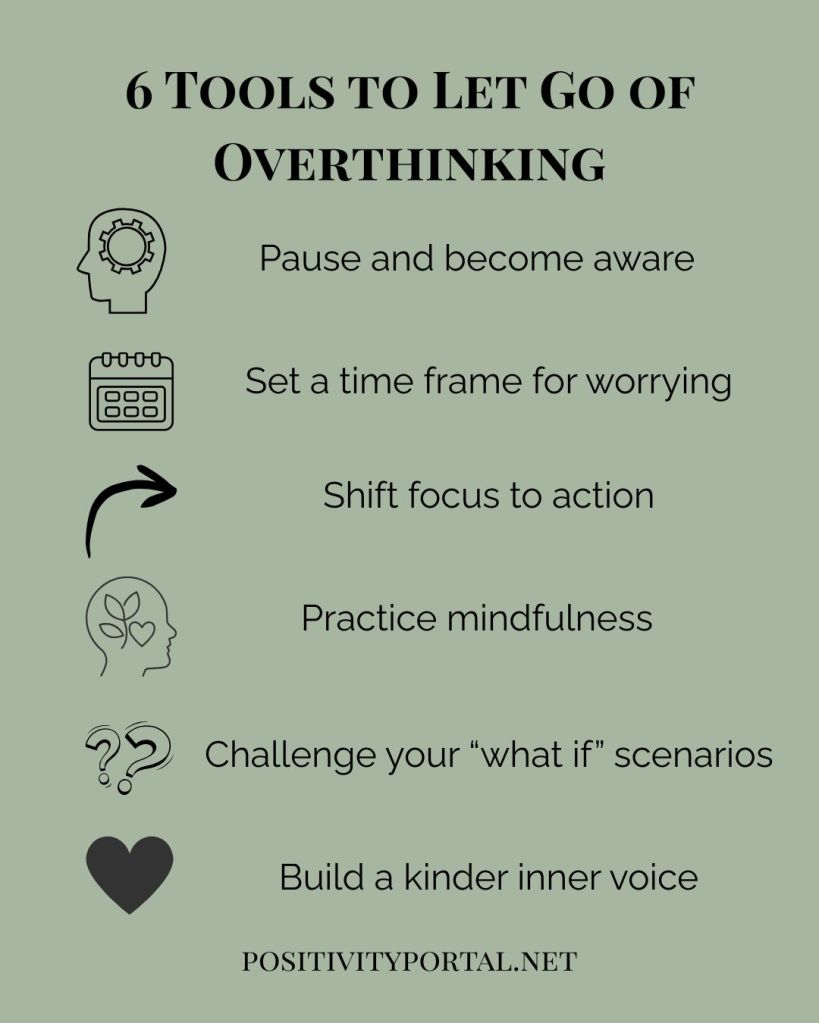
1. Pause and become aware
Start by noticing when you’re stuck in overthinking. Ask yourself:
👉 Is this thought helping me right now?
👉 Is it leading to a solution or just more worry?
Becoming aware is the first step to creating distance.
2. Set a time frame for rumination
Give yourself “worry time.” For example: 15 minutes in the evening where you write down everything spinning in your head. When the time is up – let it go. This way, the brain gets an outlet, but you don’t stay stuck as long.
3. Shift focus to action
Overthinking lives in the mind. Instead, ask yourself: What can I actually do right now? If the answer is “nothing,” shift your attention to an activity that brings calm – a walk, breathing exercise, or something creative.
4. Practice mindfulness
Thoughts tend to pull us backward (to what has happened) or forward (to what we fear). Mindfulness helps bring focus back to the present. Try focusing on your breath, your body, or something you see around you.
5. Challenge your “what if” scenarios
Ask yourself:
- What’s the worst that could happen?
- How likely is it really?
- If it happens, how can I handle it?
Often, you’ll notice the worry isn’t as big as it first felt.
6. Build a kinder inner voice
Overthinking often goes hand in hand with self-criticism. Practice speaking to yourself as you would to a friend – with warmth and understanding instead of judgment.
When is it time to seek more help?
If overthinking takes over so much that you can no longer sleep, function in daily life, or if you feel down for a long time – it might be wise to seek professional support.
Remember: You are not your thoughts. 💛 You can choose to guide them, instead of letting them guide you.
 Positivity Portal
Leave a comment